Friday, July 29, 2011

My Baby Runs on Rocket Fuel

I'm sure you've all heard the term "Now we're cooking with gas" to describe something that happens the way it's supposed to, or something that happens quickly. In terms of my baby, it's more literal than that. I seem to have given birth to a gas-powered poop machine. I know that this is in large part due to my diet, but there are some things I just can't bring myself to give up. I mean, I've given up coffee, tea, and liquor for my religion. I've given up almost all other forms of caffeine for the baby (except chocolate. I can't give up chocolate) and I only have the occasional half glass of wine with dinner or while I'm feeding the baby, to ensure my body re-absorbs the alcohol before it affects him. No really, that's how it works. Here's the chart.

So, without putting too much of a point on my weight (since you don't need a real number) I can have half a glass of wine between feedings, or during a feeding since it takes a while for my body to begin processing the alcohol, and little E does just fine. And religiously I feel OK about that. The Word of Wisdom is a doctrine that can be interpreted individually. It does not specifically prohibit alcohol, and in the gospel even Jesus drank wine, and blessed vineyards. Excess is the real enemy, and I am trying hard every day to avoid excess.

But garlic and onions and beans, I just cannot see myself giving up. I know that everything I eat, L. Itsababy eats too, and genealogically he's predisposed to being a gassy little man. But COME ON! It's GARLIC and ONIONS and BEANS! How could I possibly give those up and still be happy with my diet? I try to balance it out. I eat a LOT of fruit these days, lots and lots of apples. I drink almost nothing but water (the occasional orange soda or bottle of carbonated water) and a glass of milk every day. I don't eat food that's super spicy anymore. That's actually sad, because I have a love for Thai food that most people would consider unhealthy.  I don't eat a lot of candy or sweets... OK that might be a lie. People keep bringing me cookies! I love cookies. One of my Home Teachers brought me chocolate chip oatmeal cookies, and my husband keeps making Tollhouse cookies, and the ladies from the Relief Society who bring us dinner every other night (have I mentioned that I love my church in this entry? I love my church) have included a small pack of cookies or some dessert... OK so I'm eating a good deal of sugar. My body is craving it though.

I was shocked this morning when I did the math for how much L. Itsababy is eating now compared to how much he was eating in the hospital. At first, since the newborn's stomach is only the size of a walnut, he was only taking in 15mL or so per feeding. Now he can put down two to three ounces no problem. For reference, 15mL is half a ounce. So he's eating about 6 times as much as he used to, per feeding. And the feedings are getting closer together, too. Last night, for example, he ate at 11, again at 12, again at 1, again at 2, and again at 3. He passed out around 4 and slept til almost 9. so that's 5 feedings in about 10 hours, averaging roughly 2 ounces per feeding, puts him at 24-30 ounces of milk a day. He used to eat .5 ounces every 2-3 hours, or about 6 ounces a day. I would be shocked my body could keep up, if I hadn't read up on how to make sure it DOES keep up. Since E didn't always completely drain my reserve tanks at every feeding, I made sure to express the excess after he was PTFO. This accomplished a few things. First of all it triggered the refill mechanism in me, and second it allowed me to start a backstock of freezer milk, which is handy for things like date night and when gramma comes to babysit. And also for days like today when mommy couldn't wake herself up because she'd been awake til 4 am feeding and changing diapers, and since daddy had been snoozing through it he got to get up with baby and do a feeding because OMG TIRED.

So E is generally well hydrated, well fed, and I can't keep my hands off the foods that might give him gas. As a direct result of this we have in our hands something we call "The A$$ Cannon." The first time he went off, I thought it was one of the adults in the room. He is seriously that loud. The first time Angela heard it she commented that she was surprised his diaper hadn't been blown clear across the room. And he goes off in a series. We no longer change his diaper immediately. He should be given at least 5 minutes to get it all out of his system, else he is likely to finish on the changing table. I learned that one the hard way. It involved lots of screaming, laughing, and wipes. Hundreds of wipes.

While I'm on the subject, let me express the importance of having an unlimited supply of wipes. Preferably warm ones, if you have a boy. While all children have the capacity to spray, little boys are notorious for their distance and trajectory. And that thing will blow pretty much any time it's exposed to cold air, so having a warm wipe on hand to throw over the hose before it lets loose is a life (and laundry) saver. Wipe warmers cost about 20 bucks on average, and WOW are they worth it. Just remember to close the lid of the warmer when you're done, or else it's completely ineffectual.

So as you may have guessed, a slightly modified version of the pregnancy diet is best while breastfeeding. It ensures that baby doesn't get anything he isn't used to having, and that mommy doesn't go insane eating nothing exciting for the next year or so. Gradually introducing new foods into your system will help, and also give you a good idea of what the little one can stomach. My first "I need this now so we're going to find out if it has an effect on L. Itsababy" food was sushi. Just the cheap stuff you get at Safeway (Vons, if you live in SoCal, Kroger, Whole Foods, Trader Joes, etc...) by the deli counter at first, but gradually ramping up to an actual hand roll at an actual restaurant. I don't eat a LOT of raw fish, but I do eat a decent amount of cooked fish and chicken. Red meat upsets my stomach some, and TJs to a greater extent, so we've been phasing it out for a while. And pork is kind of an in-between. In general we eat fish and fowl for our flesh protein. om nom flesh.

I imagine I'll have to lean more towards the vegetarian side with L. Itsababy, but that's ok with me. As long as I can have a diverse field to select from, I'm happy. And with friends like Karla over at the Veggie Noms, how could I ever lack for interesting recipes? Seriously, go check her stuff out. She makes things be tasty.

Thank you, Ladies

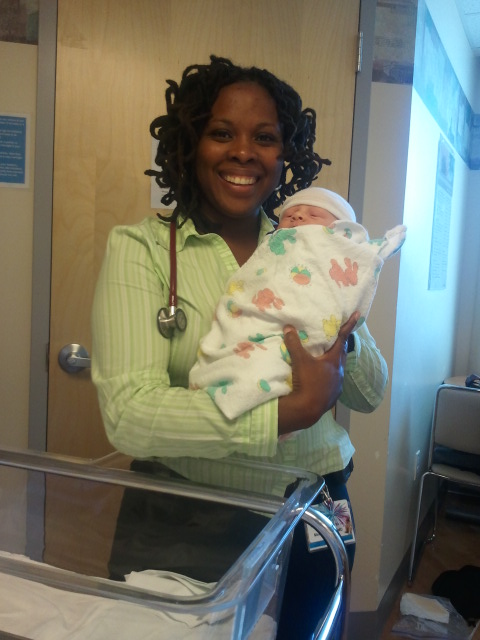
I'd like to take a quick moment to recognize the fabulous women who worked on my team at Kaiser Santa Clara. I don't have all their pictures, but here are the ones I do have:


Dr Johnson


Kelly


Amy The Fabulous Med Student. Also me, looking kinda funny.


Liz!


Aimee


Hilary


Dr. Chang


Kathleen


Evelyn


Cassandra! Fabulous Half Fairy Wonderment!


Dr. Ross


Janice


Not Pictured: Sungmi, Young Kim, Dr. Bader, Sarah, any of my male attendants. If I missed anyone else, or if I got a name wrong, I'm sorry; I was on meds.

Thursday, July 28, 2011

Coming Home Again, for the First Time.

So there are many things that happened at the hospital that I just haven't had time to cover yet, and I'm sure I eventually will have time, but that will be later. Perhaps much later. In the interests of moving along, we'll move along home. Or at least we'll try, because it took FOREVER to leave the hospital.

A good deal of that is because of just how cute L. Itsababy is. I know that sounds kind of pretentious, and a lot of you are thinking to yourselves "well every mother thinks their baby is the cutest thing ever" but seriously people, it wasn't me showing him to everyone squealing "look how cute!" or anything. In fact, for a good deal of his cute getting in the way it was people either approaching me to mention how adorable he is, or else people who were supposed to mention his adorability in passing spending forever cooing over him. Case in point: the portrait lady. I know, I know, they pay her to talk about how cute my baby is so that I'll buy the prints. But I have a modicum of circumstantial evidence! The people ahead of us, they got 15-20 minutes with her. She took the portraits, cooed the appropriate amount, and then moved on. She then spent 45 minutes with us, trying to find the exact right poses, taking a ton of pictures, and then fretting over which shots to use, since she could only give us 8 poses in our package. And just to show you I'm not being silly, here's one of them:


So don't go telling me it's in my head. This is what he looked like 48 hours old. No squishy red face, no wrinkled crybaby, no real George Burns look to him at all. Just perfect little baby boy. And his daddy's hand, because daddy is the strong. And that's a hospital sheet in the background, not some special backdrop or anything. He's just perfect like that.


We had planned to be out by 11 am, and left ourselves about 45 minutes to get our stuff together, get dressed, get L. Itsababy dressed, and sign out. However since all that time was taken by ordering baby pictures, we ran into a bit of a time crunch. Not that the hospital was being put out. Apparently the week's baby rush was now over and they even mentioned to me that I could stay til dinner if I needed to. I almost took them up on that, too, because something scary had just occurred to me. I was going home. Home to where there were no nurses to help me with remembering to take my pills on time, no one coming in with food reminding me to eat well, no lactation consultants making sure I was feeding L. Itsababy correctly... we were going to be on our own! My anxiety was starting to make a comeback.

I know I've mentioned in passing that I have an anxiety disorder, but I don't think I've really elaborated on how much this used to rule my life. Over the past 6 years or so I've managed to keep it under control with the help of my fabulous husband and a LOT of introspection. Before that it was medication. Lots of medication. Medication to help me sleep, medication to help me think, medication to relax the muscles in my body (which I still occasionally took up to finding out I was pregnant) when I couldn't do it on my own... I did that for years. I had a traumatic experience in college, which triggered a break. When I sought help I hadn't slept in about a week, and was starting to have aural hallucinations as a result. Yeah, I was messed up. As a sad result of the anxiety, I am at a much higher risk of postpartum depression. I've had a few moments since coming home when the stress was just too much and I needed a few minutes to regroup, but sitting in the hospital all I could think was "I'm going to go home, and something's going to go wrong, and it's going to be horrible."

So maybe I dragged my feet a little. Maybe when they gave me the paperwork to sign so we could leave I asked questions. Maybe when Amy came in to say goodbye I spent some extra time talking to her. Maybe when we got L. Itsababy dressed in his cute little dicky outfit I took him on a walk to find Cassandra so we could say a proper goodbye. Maybe I spent a little extra time getting my things from the pharmacy...but they had just handed me a baby. MY baby. This tiny, beautiful little life that was mine to take care of, but not really mine. Just entrusted to me for a while, to form and shape and screw up as I may. They gave me a PERSON and said "OK, here comes the hard part, and it just keeps getting harder. Good luck!"

Of course they didn't really just give him to me and tell me to suck it up. They even assigned me a social worker because of the history of anxiety, a nice man named Raj. They gave me a giant list of phone numbers in case of emergency, and reminded me that they're there to help. Or course the amount of help I'm getting from non-hospital sources is amazing as well. With Angela, my family, TJ's family, my friends, and my church, I have only had 2 real breakdowns, one a week. And considering I haven't had a period in 9 months, this could all just be hormones. I intend to treat it that way to a certain extent. Not that ignoring feelings is a good way of dealing with them, but I have so much to do right now, and so little time to do it in, that I can't afford to be freaking out every time I have a sleepless night. If I don't take a nap that's my problem to deal with, and if I overwork myself and go for too long of a walk it's not like L. Itsababy's going to stop needing me for a night. I can't just take a night off from being a mom. I'm a FOOD SOURCE for land's sake. So to a certain extent, yes, I have to suck it up. I'm trying to do that right now even, writing and not editing because I'd rather get another hour of sleep than find my run-on sentences and comma splices.

But hey, they say you can't go home again, right? Right. I left home a wife and a woman but I came back a mother, and the home I had isn't the home I have now. It's all different, and while some of it may be frustrating, and approaching too much, it's all worth it when I look at him.

Monday, July 25, 2011

Being a Strong Mother is Hard Work

Shortly after L. Itsababy was born they prepped a Mommy and Baby (forthwith M&B) room for me to occupy for the next 24 hours (which turned into 48, but more on that later) and Hilary wheeled my still-drugged-and-temporarily-paralyzed self down the hall to scope my new digs. The room was smaller than the L&D room, but had all the same furnishings, minus the emergency equipment. And the bed was MUCH more comfortable, though too small for me. One of the drawbacks of being over 6 feet tall is that things designed specifically for women do not fit. Even beds. But cramped as it was, it was a solid state bed, with no removable bottom half (which the L&D beds are all equipped with, for ease of delivery) to create the kind of cracks that those who have slept on two twin mattresses pushed together will recognize as both uncomfortable and, if not dangerous, then at least worrisome.

Not surprisingly, L. Itsababy and I slept. The lady came in with lunch, and I ate, and I tried to get L. Itsababy to eat, but it took only about ten minutes before he went back to sleep. I figured he'd had a big day, and went back to sleep myself. We slept. And slept. And slept. I occasionally got up to pee, which is no small feat when you're sewn together the way I was. They give you this peribottle to use, and tell you to not wipe, but just rinse and dab. They are not kidding, this is the only way to do it. Learn to love the peribottle. Take it home with you, you're going to need it. The bleeding takes a few weeks to stop fully. I am currently still waiting to stop bleeding. And they say I wasn't even that bad, so I can only imagine how bad it can get. Though I did apparently somehow manage to lacerate my urethra. So yeah, peeing was awesome. And by awesome I mean WHERE ARE THE PAIN PILLS?

Eventually the nurses came in and told me that I had to wake up L. Itsababy and feed him. But there was a problem. I couldn't wake him up. I mean, he'd wake up for a second, and his eyelids would flutter, and he'd go back to sleep almost instantly. The nurse, Kim, told me that I needed to wake him up and feed him, and then left. I tried everything. I tried rubbing his feet, tickling him, blowing raspberries on his stomach, I tried ICE CUBES on his feet, and on his face (My mother used to have to hold ice to my face to keep me awake while feeding me as a baby, this is NOT cruelty, I swear). Nothing. Poor kid was tuckered out like nothing I'd ever seen before. We knew he was getting SOME nutrition because every so often he'd wake up, poop, and then pass out again.

Then the nurse came in and told me that they needed him to eat, because they needed him to pee. If he didn't pee in the first 36 hours they were going to have to either start a pediatric catheter, to check his kidney and bladder function, or they were going to start supplementing him with formula. I kind of flipped out at the nurse at that one. My baby would NOT be put on formula, I told her. I was NOT going to be feeding my son some scientific concoction that "approximated" something my body could make very well on its own thankyouverymuch. I requested to see a lactation consultant, requested a new Ice Diaper, and sent the nurse away.

Let's take a quick moment to recap the benefits of breastfeeding. America is actually not considered a breastfeeding culture anymore, because the average breastfeeding woman does it for less than 9 months. The average worldwide is 3 years. Now a ton of women reading this (and probably some men) just recoiled in horror, thinking of social stigma, regressed development, feeding in public, and most importantly, TEETH. But breastmilk can also be administered by bottle,  if you're worried about pretty much any of those things. But of course that takes time, and I am usually not one for extra time taken, even if it is just for pumping and bottling. So I prefer the old fashioned way. The way our bodies are designed to do it. I mean cmon, ladies, they're not for decoration. If you're religious, then God gave them to you so you could feed your children. And if you're not religious, then you evolved specifically to have those particular glands whereas your partner (or sperm donor, or whoever) does not because you're supposed to use them to feed your children. It's fabulous that you love the way they look, but seriously, they're utilitarian devices. Also if you think they look nice now wait til you've been breastfeeding for a week. They get bigger. And fuller. And if you're not careful they turn into something you'd see in a fetish movie.

But I digress. The benefits of breastfeeding, for the baby: faster gut sealing time, more highly functioning immune system, easier to digest, lower chance of diabetes (types 1&2), lower chance of heart disease, lower chance of many types of cancers, lower chance of asthma, lower chance of obesity, lower incidence of ear infections, and even a lower chance of infant and childhood leukemia. Before your milk comes in fully, your body produces something called colostrum, which is essentially a specialty food for newborns. It's a clearish yellow color, and is basically pure nutrients and antibodies. You won't produce much at a sitting, just a few teaspoons or so, but that's fine. I started hand-expressing mine into a bottle as soon as it started coming in, and by the time L. Itsababy was born I had 15 mL stored in the freezer. Considering the average newborn's stomach is between the size of a hazelnut and a walnut, that's a LOT of food. It took him a few days to put it down, in collaboration with my rapidly changing milk.

The benefits of breastfeeding for the mother: quicker bonding with the baby, lower chance of postpartum depression, lower chance of ovarian and breast cancer, faster weight loss (your body burns a LOT of calories making milk) faster uterine contraction (yeah it's a bit crampy, but getting back to normal quickly is a good thing), lower chance of type 2 diabetes, saves money, saves time (you don't have to sterilize nipples and bottles all the time), breastfeeding releases oxytocin into the bloodstream, so it actually feels pretty good, more sleep (no bottles to mix and warm at 2am, just scoop the kid, feed the kid, put the kid back to bed) and less time lost at work since your baby will get sick less often.

Also to be taken into consideration is the affect breastfeeding has on society. I'm not going to get all super-preachy (well, no more than usual) nor am I going to turn into a propaganda film, but it is important to note that since breastfeeding decreases the risk of so many illnesses that there is in fact an impact on society, in the amount of medical care and provision a mother and baby will need, if nothing else.Of course there ARE other things (environmental impact, workforce impact, etc) but the one you're probably not going to think of is the medical provision, so there you go.

Unfortunately, once a baby is given formula from a bottle it can be very hard to get the child back to breastfeeding, since bottle feeding can be so much easier for the baby (it's hard work to use those jaw muscles for the first time!) and can take so much less time (though that also makes babies gassy, and then they spit up when they overflow) so it's important to be consistent.

Now that we've covered why I will be attempting to exclusively breastfeed, let's cover something else I said really quickly. Ice diaper. OMG ice diaper. My cousin K, who last year also had a beautiful little boy, told me about these fabulous inventions. They involve taking a newborn diaper, ripping it open, stuffing crushed ice between the desiccant and the fluff, and then stuffing them in your hospital-approved undies. It doesn't sound pleasant, but when you're swollen, bleeding, stitched together, and sitting on two maxi pads and a folded up chuck anyway, (those blue thingies, remember?) it's pretty appealing. The numbing sensation is fabulous, and since the diaper is designed to absorb, you don't have any uncomfortable wetness other than what your body is producing on its own. Cassandra, the nurse I dubbed "some sort of magical Sookie Stackhouse half-fairy" makes the best ice diapers at Kaiser Santa Clara, from my experience. She never over-fills them, never forgets to crush the ice, and always keeps the diaper tabs tucked away so they don't scratch.

When Kim came back with my ice diaper she reminded me that if they hadn't seen a wet diaper within 36 hours of birth, they'd be calling a doctor. I reminded her that I did not want my baby on formula. I then grumbled at length to myself and my mother-in-law, who was visiting, about how I knew the baby was eating, I knew I was producing enough food, and that if it came to 36 hours without him producing a wet diaper I would prefer them to catheterize, thank you, since eating wasn't the problem and I'd like to know what the problem really WAS.

But wait, you may exclaim, how DID you know your baby was eating enough? If he was still producing meconium, and he wasn't peeing, how could you know? Easy. I took choir. Therefore I know how to count beats. L. Itsababy at that point was sucking about 5 times before swallowing, which was audible, then resting for five to ten seconds, then repeating. He'd fall asleep after about 5-10 minutes of that. I'd be sure to try to wake him up every hour to feed him a little more, letting him pass out when he was tired. At that point (almost 24 hours in) he would wake up when his feet and arms were rubbed, or when he had a thermometer placed in his armpit, which happened just about every 7-8 hours, in keeping with hospital protocol. He also would get fed after he came back from any of his myriad tests, or whenever the pediatrician would come visit, or when the nurse would come to see if he'd peed yet. Which he had not.

We were just rolling into 30 hours when the lactation consultant showed up. Janice, a lovely woman who referred to L. Itsababy as "Mr. Baby" and continued to lead him through extensive "waking up exercises" during our session. When even she could not convince him to stay awake she taught me how to cup-feed, which involved hand expressing into a small medicine cup (she commented on how I didn't seem to have any supply issues) and then letting L. Itsababy half-drink half-lap the milk to make sure he was getting enough. I was right, he was. Just two hours or so after my meeting with Janice, L. Itsababy gave us the wet diaper we had been waiting for. He actually completely soaked it. It was like someone had taken a Super Soaker to that thing. However, I was slightly frightened to see that there was some blood in his urine, and called the nurse immediately to tell her. Turns out that blood in the urine is completely normal for the first wet diaper. Babies had a tendency to swallow some of their mother's blood during delivery, since they're all covered in it and stuff, and they don't process it so well.

After being reassured, we both fell asleep. Again.

And now it's time to feed the little piglet himself, so the rest of this story shall have to wait a little longer.

Thursday, July 21, 2011

Labor and Delivery, Part 2

Picking up where we left off, I had wimped out and decided that the pros of an epidural far outweighed the cons. And those are some serious possible side effects. To recap quickly, those would include paralysis and death. The chances, however, of dying or becoming a paraplegic under the hand of a skilled anesthesiologist are pretty remote. It does happen, but not very often.

So it was about 3:30am (according to my mother's text updates to my brother) when I requested the epi. I assume it took about 5 minutes for the anesthesiologist to come in. We all remember Liz the anesthesiologist, right? The lovely lady who finally got my IV in? I was in luck, and she was still int he hospital. So when she came in I got to say "Hi Liz! You're going to make the pain stop, right?" and she got to reply "Hi Alix, yes I'm going to try" and then we got down to business. If i had not gone through the IV problem earlier, I would have had to do some paperwork and listened to the side effects and indications and confirmation questions at THIS point, when I was in pain and tired and shaking every time I had a contraction. Instead Liz just got out the needles and told me to sit on the edge of the bed.

The best part about the epidural is that the person it's being done to doesn't have to see any of the instruments. My mother, TJ, and Angela were not as lucky as I. Angela, a former fire fighter who has seen some pretty gruesome things in her life, later told me she had to sit down to keep from vomiting. My mother, a nurse, got eyes as big as saucers looking at some of the hooks and needles. My husband TJ was standing right in front of me and trying to keep me distracted, and he still says that watching me get the epi was the hardest part of the labor and delivery, including the parts with waves of blood.

The worst part about the epidural (excluding the anxiety of "OMG is this going to leave me paralyzed") is the Lidocaine. Remember how much I hate Lidocaine? Evil nasty painful burning stuff? Getting it injected into your back is not better than getting it injected into your hand. Liz however is a consummate professional. She talked me through every movement of her hand, from "I'm going to be putting some betadyne on your back to clean off the work area, and draping it now" to "I understand why you jumped there, and it's ok, I figured you'd probably pull away because most people do but you're going to have to do this again and then it'll be over" before I went almost completely numb. I say almost because you can still feel pressure. The threading felt to me like someone slowly running a finger down my back, but like they had somehow bypassed my skin and fascia. The only exception was what they called getting a "zing" in my back. It felt like a short electrical impulse, and was only on one side of my back. Of course I freaked out a little, but Liz assured me that it was completely normal, and what she was doing to fix it, and how it was going to effect the rest of my epi. Apparently she needed to withdraw a little and go around a nerve cluster, and the side of my back with the zing would be affected slightly differently than the other.

When the thread got seated I was instructed to run through some basic movements to make sure there was no damage, and then it was taped in place. By like half a roll of tape. Easily half a roll. I have a mild allergic reaction to some kinds of medical tape, so I had checked ahead of time what kind of tape they were using, and BOY was I glad. Usually I can stand the "wrong" type of tape when it's on something small, like holding a cotton ball over an injection site, but this amount of tape would have had me breaking out in hives you could have seen from space. Then she attached the threading to a dispenser, which she taped up over my shoulder, and helped me lie back in bed.

Then my body disappeared from the bottom of my rib cage to the tops of my ankles. I was expecting to not be able to feel them, but what I was not expecting was being unable to move them. I instantly freaked out again. I was sure I had just fallen into that .01% again. I say again because I've had mono 3 times and L. Itsababy was conceived while we were using condoms. I'm used to being a slight medical anomaly. But no, I was not paralyzed. When I calmed down I realized I could in fact feel pressure on my legs when people touched me, and that the nurses were not freaking out with me. In fact they were taking this time to prep a catheter for me. Suddenly the need to catheterize epi patients made a TON more sense. If my legs don't work of COURSE I have to be cath'd. The weird part was still being able to move my feet. It was like they were somehow floating below me, still attached but by some invisible thread only. Like when you light up last year's string of Christmas lights and there's a giant chunk in the middle that no longer lights up, but still relays electricity to the last few lights on the strand.

It was 4:30 am, I was 4 centimeters dilated, and I was more comfortable than I had been in months. I fell sleep and let my body do what it was going to do.

And apparently what it was going to do was progress VERY quickly. I woke up a few times when the nurses came in to check me, including once to say good morning to Hilary, my nurse from the observation room, whose voice I recognized without my glasses on (I have a negative 7 sphere AND am astigmatic, this is an accomplishment) but would promptly fall back to sleep. Around 9:30 I was inspected and told that I was at 9 1/2 or 10 centimeters, and they were calling the doctor in because it was time to push. I had progressed over a centimeter an hour for five hours. That is extremely rapid, especially for a first birth and an induction.

When Dr. Bader came in and introduced herself I was starting to feel pressure from L. Itsababy having fully dropped. There is no kind way to say this. It feels like you have to take a ten pound poop. The muscles you use to push out a baby are essentially the same muscles you use to have a bowel movement, which is why this skit involves the phrase "shameless bowel movement." Because a lot of women poop on the table. One more reason I was suddenly glad they had taken me off solid food.

Now there's one more thing I need to tell you before we get into the actual delivery. I did not go to any birthing classes. I went to newborn care classes, breastfeeding classes, infant first aid and infant activity classes, but when the time came for me to sign up for an actual birthing class, they were all full. Apparently the San Francisco Bay Area is experiencing a baby boom (remember the poor lady delivering in her observation room?) which is being partially blamed on the Giants making (and then winning, YAY! ) the World Series last year. But this means that I was essentially unprepared. I mean, I had read books, I had done my specialized exercises, I had researched what I was supposed to do, but no one had SHOWN me. I never really feel prepared until someone has seen me practice and told me I'm not wrong. So I was scared.

I didn't need to be. The best advice I got through my entire pregnancy came from my mother, and it applied to this situation more than any other: "Your body knows what to do, just get out of its way if you can't help." We told Hilary that I hadn't gone to any classes and she assured us that the nurses on staff all knew how to help me get this going right, and comfortably, and would be glad to help. It was 10:00 and they told me to push.

And wow did I push. Throughout my pregnancy I had been doing a particular type of isometric crunch in order to prepare these muscles. Essentially you take a normal crunch, get to the apex, and hold it for 30 seconds while you do proper kegel exercises. Now I know a proper kegel exercise involves not having your abdomen tense, but the important part here is to separate the abdominal muscles from the kegel, and to keep your rectum as relaxed as possible. The expectation is to be able to hold the crunch for up to a minute, while doing 30 kegels in that time. It takes a loooooong time to work up to this, so don't feel bad if you can't do it right off the bat. If you can hold a full crunch, with no pulsing, for 5 seconds at the beginning, you're doing better than average.

The reason these exercises worked was starting to make itself VERY clear. When you push, they have you curl around the baby, and bear down like you're trying to push out a huge bowel movement. You push with every muscle you can possibly push with, and you want to be able to be relaxed where you need to be (in the rectum) while you do it. This prevents a ton of tearing. Since they rarely do episiotomies anymore it's important to know that you probably WILL tear. With perineal massage or dilation it will not be as bad as it would have been without, and if there's a chance of third degree laceration they might still cut, but in general the faster the baby descends (like, say, from -3 to +3 in 5 hours... yay me) the more tearing should be expected. Also speed of delivery plays a large part in tearing, and since my delivery was particularly quick, I was extremely glad for the exercises that had taught me to keep control of the muscles I was using (and the few I was pointedly NOT using)

The first few pushes Hilary and Dr. Bader had me do in a style you see frequently in movies. They had my legs up, and I was to hold onto the back of my knees and use my arms to pull myself down while pushing as hard as I could. This worked pretty well, and we stayed like that for maybe 10 minutes. Then Hilary pulled out the stirrups and handlebars. No joke. Since I had 3 people on my support team this was optimal for me. My mother braced one leg, Angie braced the other, and TJ curled his big manly arms around my back and helped me push from behind. Which I had specifically requested since I was not for one instant letting a man with that much desire to photograph or video my delivery near an angle that would make that possible. I'm an open and progressive woman, but no one wants to see that. And i don't really want them to see it if they do. There are plenty of gross pictures out there, and he ended up taking one gross one anyway, so bah.

From that point the hard aprt was keeping L. Itsababy descended during the period of time when I was not pushing. They do pushes in sets of threes, with breaths in between. Each push takes 10 seconds, then deep breath and push again. Did the timing for the isometrics just click in your head? If you can relax your back and take a deep breath WHILE KEEPING YOUR ABS TENSE in between pushes, you can keep the baby from sucking back up into your body (a weird feeling, btw) and losing you your progress. My best advice during this part is to not laugh. My mother made me laugh and I lost my push big time. The pushes are in concert with contractions, so they're a minute or so apart, unless your doctor tells you to skip one and rest. Which is neither lovely nor painful, it is simply a period of time when your body is screaming "PUSH!" and your mind is screaming "NOOOOOOOOOOO" and then it's over and you can breathe until the next push.

I was pushing for 45 minutes. L. Itsababy was helping considerably. At one point I was holding my push, they told me to breathe, and the little sucker found foot purchase on my ribs and decided mommy couldn't do it on her own and he needed to intercede. When I finally DID get the head out the next thing out was his arm, followed by a little wave of blood as he LITERALLY HELPED PULL HIMSELF OUT. Talk about a weird feeling. Not painful (thank you epidural) but definitely odd. And then they put him on my chest and my whole world imploded into that tiny little face. If you've never believed in love at first sight, this experience will make you believe. Logically I know he was kind of grey and covered in blood and mucus and vernix, and that he pooped on me two or three times before they took him off of my chest to weigh him (8 pounds 11 ounces! POST POOP!), but logic has nothing to do with the way I felt in that moment. He was the most beautiful thing I had ever seen, he was my sun and my moon and my stars, and he always will be.

Tuesday, July 19, 2011

Labor is an interesting thing... part 1.

So, picking up where we left off, I was just moved to the L&D room, and hadn't eaten anything in a few hours.

My new nurse Aimee started my pitocin drip immediately. Since I had chosen the saline lock IV and the doctors knew it was going to take longer than two hours to get me a baby, she started the pitocin, the penicillin, and the D5 solution (D for dextrose, 5 for 5%) at the same time. The pitocin needs to be increased slowly, since every uterus is different. They don't want you suddenly cramping so badly that you hurt yourself, or the baby. They start at 2 milli-units per minute and increase by 2 every half hour or so. I was also re-hooked to the fetal and uterine monitors, and continued to watch L. Itsababy bounce around like a jumping bean. At this point I had been in latent labor for 26 hours, and was very happy I had decided to go with the pitocin. Of course it's a personal decision, but I was looking forward to a relatively speedy labor after that. I also knew that for most women, postpartum, they hook you up to pitocin anyway, to help contract the uterus back to its original size. If a C-section is needed, the hospital will almost assuredly hook up the pitocin, since the body cannot really process what just happened, and otherwise would wait until the first menstrual period to start contracting. Or so I've been told by several women who were relating their C-section experiences.

Since it was about 10 o'clock at night, my support system (my mother, my husband, and Angela) camped out in the L&D room. They had one chair that folded out to a twin cot, which TJ took; Angela set up a sleeping bag on the floor; mom took the rocking chair, swearing she was going to stay awake as long as it took. She actually did, too, only taking a short nap while everyone was asleep. There was another shift change at 11, and I met the nurse who would be taking care of me for the majority of my active labor, Sungmi. She was lovely, and was very good at explaining what I could expect to happen while attached to pitocin. Which is good, because I went through most of the "possible side effects of labor" that she had described in a relatively short period of time.

It took about two hours for the pitocin to start kicking my butt, but when it did WOW did it pack a punch. I was suddenly very glad I had been told to stop eating solid food, since I am apparently that woman who vomits during labor. Because if having all your abdomen muscles contracting for the baby weren't enough, vomiting and having the rest of your body start to contract too will put you right over the edge into the aerobic exercise arena. I was sweating, and it had nothing to do with heat. Sungmi had previously offered an anti-emetic (to prevent vomiting) when I had started to feel nauseous, but I had tried to tough it out since my birth plan specifically said I was going to try to do this with as little chemical help as possible. It occurs to me now how silly that must have looked: "yes, hook me up to the induction chemicals and the antibiotics but I'd prefer no pain meds, please." I am truly special some times. So when I started vomiting, I requested the anti-emetic, and boy was I glad. Shortly after that was when my next labor curveball showed up. I apparently am a labor-shaker.

Some women (like me) experience something similar to shivering when in labor. The labor shakes are extremely annoying, but more than that they really put a damper on the types of natural pain management that most people suggest. Walking helps greatly with labor pain, but if your knees won't stop knocking, getting out of bed and walking the ward isn't much of an option. Shoot, getting out of bed and using the bathroom wasn't much of an option. I actually almost fell twice, and had to wait through two full contractions the one time I did try to bravely make my way to the toilet. I say "the once" because when you chicken out and go for the epidural, they catheterize you. Yeah, the "I'm going to do this with alternative pain management" chick ended up with the thread in her back.

This brings up a good point though. Flexibility in the birth plan is EXTREMELY important. The doctors really ARE trying to help, and if they suggest something, there's probably a good reason for it. Try to get as much information ahead of time, before the pain and the delirium set in. When you are 6 centimeters dilated and everything hurts and you haven't slept in way too long, the last thing you want to do is focus on the list of side effects of different medications and try to make an educated decision. Get all that out of the way ahead of time, so if you have a preference you can voice it. I had spent some time researching, and deciding when was going to be "enough pain" for me. It turned out that at about 2am, lying on my side crying, with my mother guiding me through breathing exercises was when I whispered "I can't do this anymore" and they came with that sweet, sweet needle of Fentanyl. What I had not been expecting, however, was that my body processes Fentanyl quicker than the average person, and what should have lasted an hour only lasted about 35 minutes. Before I could have another dose, I was back in the same pain. Before that could happen, though, my water broke. For real this time.

I felt particularly silly after that. They all told me "you'll know if it happens" and "there's really no mistaking it" but I still had told the admissions nurse "I think my water broke" and "I think I may have partially ruptured." Yeah, no. There really IS no mistaking it. I felt a pop just above my cervix, and suddenly I was leaking. My husband, God bless his soul, was so interested that he actually reached down and touched it. He has one of those "oooh, what's THAT about?" kind of minds. His term for what it felt like is "thick water." For me it was kind of goopy feeling. Like a mildly viscous solution. And it didn't stop. It takes about 3 hours for the amniotic sac to replenish itself, and the seeping just kept going on and on and on. They put me on my side, with a pillow between my legs, covering the pillow in one of those lovely blue absorbent cotton-and-plastic "chucks" that I was falling so much more in love with by the moment. There really is no mistaking that feeling. If you ever think to yourself "I think my water might have just broken" the answer is no, it didn't. Because when your water breaks, there is no "I think it might have" about it, there is simply the statement "my water just broke."

After that, and then the slow return to pain from the Fentanyl wearing off, I decided that enough was enough. My mother had helped with my breathing as much as possible, the drugs had allowed me a moment of respite to calm down and rationally think this through, and I was dreading what I knew was coming. I called for the epidural.

Monday, July 18, 2011

12 hours of observation - A Love Story

So. When last we saw our heroine (me) she had been left hanging on the phone call that could change her life in a flash, the induction call.

Cut to early morning, grey light just beginning to filter through the blinds. A young (I can dream) blonde woman lying in bed, on her side, asleep. Suddenly, her eyes fly open, and a hand fumbles under the sheet, coming back wet. A look of mixed confusion and horror comes over her face.

Yup. I totally thought my water had broken. Apparently this is because I am a very silly woman. I was wrong. However, I called the Labor and Delivery (L&D forthwith) department and dutifully told them that I was leaking fluid, how much it was, how far apart my contractions were, how painful they were (more painful than a stubbed toe, less painful than a broken bone. I was helpful) and how long they were lasting. After a long pause, I was told to come in for observation. I promptly woke up TJ, who I had courteously decided to let sleep until I knew what was going on, and told him to take a shower because (in Angie's words) it was FREAKING GO TIME.

A flurry of activity followed this call, as I'm sure you can guess. However you might not realize how much of that was trying to gauge how long we'd be there, and the appropriate amount of food to bring. Apparently I take after my father, who when it was suggested he make his own food for the labor of his firstborn went into a cooking frenzy for multiple days. In his case it turned out to be a good thing, as my mother was in active labor with my older brother for 72 hours before she had a C-Section. Even after that, she was afraid people would think she was a wimp for taking the easy way out. After 3 DAYS.Yes, that is the kind of strong woman who raised me. I, however, was not in labor for 3 days. I was not even in active labor for 1 day. However I was not thinking very clearly, and essentially my process went "hospital food is nasty. We have good food. Let's take good food and not eat the nasty." My thought process forgot to consider the possibility of not having a refrigerator available. So into the cooler went fruit, and cheese, and some delicious kielbasa I bought at the farmer's market from a man who seemed a bit too gruff until I realized he was cranky and Polish, two things I identify with greatly. In went juice, and crackers, and oh so many delicious things to snack on. And then we were ready. Except TJ was still in the shower. So we loaded up Angie's car and waited for him to emerge, pink and clean. When he did he let us know he was planning on taking his own car, and would meet us there.

All our test runs to the hospital had taken about 15 minutes. This one took 6. Somehow I walked myself up to the L&D without the use of a wheelchair, carrying my purse and medical folders while Angie carried the cooler, my overnight bag, and her laptop. Angie is Much Woman, Small Package. The check-in process took less time than we had thought it would, since we had done all the pre-admission forms weeks before, and had called to announce our impending presence. We were escorted to an observation room after only a short period of nervous banter and stress-jokes. I specialize in stress jokes. I am hilarious when I am scared.

The observation room is a small, windowless cubicle in a short hallway. It contains a steel slab bed with a foam pad on it, a chair, a stool, and a few random computerized things. One is actually a computer. Another is the monitor. No not the computer monitor. The monitor they hook to the outside of your belly to measure the interval and duration of your contractions, the baby's heartrate, and the fetal movements. It became very apparent very quickly that L. Itsababy was awake, moving, and that my contractions were indeed 5 minutes apart and about  a minute long. We finished my admitting paperwork and I started waiting for a real room.

And I kept waiting. And waiting. And waiting. My nurse, Hilary, who had introduced herself immediately after I was admitted came in and told me that an OB would be with me shortly to check my amniotic sac, but since I hadn't yet overflowed the maternity pad and chucks (blue absorbent pads covered in cotton and lined in plastic) they had under me in the four or five hours I'd already been waiting, they were pretty confident that I had been mistaken. When Dr. Holland came in and checked me 10 minutes later, it was confirmed that I was, in fact, not in active labor. I was in what is known as "latent labor," a kind of warm-up period. Think of it as stretching before a marathon. They decided that this would therefore be the ideal time to set up my IV saline lock.

I am what is known as GBS Positive. i have a form of Strep, Strep group B, which can be transferred at delivery if there is no antibiotic given to the mother. So they had to have me on Penicillin, one bag every four hours, between the time the induction started and the time I delivered the baby. Since I was also considering IV pain meds, and would be on the IV Pitocin, I opted for the saline lock. While part of me is glad I did, part of me wishes I could have done this med-free, if only to avoid the hassle that ensued from that lock.

I apparently have troublesome veins. By this time Hilary had gone off shift, and had been replaced by Kelly, another lovely young lady. Actually one of so many lovely women who took care of me that I started taking pictures of them, knowing no one would believe that so many gorgeous women work in L&D without physical proof. As such I have pictures to present later of almost every woman who worked on "my team." I'm just missing a Dr. Bader, a Young Kim, and a Sungmi before I have collected them all! I think. I don't really know. The drugs were good. Anyway, my veins: they call me a "hard stick," which I of course mentally retort with "that's what she said" and then giggle to myself. Kelly tried both the vein in my right wrist and the back of my right hand. The same thing happened both times, which is to say that the IV went in, but when she tried to retract, the vein blew. Then she called in reinforcements. After four nurses checking for places to stick me (again, mentally giggling) and a few more blown veins, they called in the BIG GUNS. Liz from Anesthesiology finally got the vein in the back of my left hand to function, after a shot of lidocaine and four pitchers of water. I hate lidocaine, btw. Nasty evil burning painful stuff. I like what it DOES, of course (numbs like whoa) but the actual injection is not very fun. Liz then decided since she was already there, and I had put in my birth plan that I was considering an epidural, that she would do my epidural paperwork then, and get it out of the way.

Liz then sprung on me something I was not quite prepared for. Since my epi paperwork was finished, I was now NPO solid. That is to say, I was no longer able to eat solid food until after the epidural wore off. At this point I had been in the observation room for almost 8 hours, and had eaten almost nothing. A cafeteria turkey sandwich had graced my stomach perhaps five hours prior. Remember that giant cooler I packed? Apparently when I'm that nervous I have very little interest in eating anything that cooler contained. Cheese? No thanks. Sausage? What was I thinking? Fruit? Who has time to eat fresh fruit? It's all messy and then you have to find a place for pits/seeds/cores. But mention just once to a pregnant lady that she can no longer eat, and suddenly she's ravenous. Too bad for me. Less bad for my mother, brother, Angie and TJ, who were by this point taking turns staying with me in the ONE VISITOR ONLY observation room.

Another shift change came and went, along with a visit from my Medical Student, the lovely Amy Wasterlain. Let me tell you right now, this girl is going to make one HELL of a doctor. She's absolutely fabulous. Communicative, easily understandable, knowledgeable, gracious bedside manner, personable, and quite obviously sharper than the average tack. Amy told me that while Kelly was going to be staying with me as my nurse, she herself was going home, but that she'd see me tomorrow and probably the day after. Another few hours came and went, along with an unexpected surprise in the observation room next to mine. Apparently, since there was such a shortage of beds, the woman who had been admitted to the room next to mine had actually GONE INTO LABOR AND DELIVERED A BABY without getting to leave her observation room. I suddenly was very happy I was not in active labor. Those steel beds are hard enough to deal with, without having to be in a situp labor position on them. And then Kelly came back in with fabulous news. Several women had recently delivered, and they were being moved to the Mommy and Baby (forthwith M&B) ward. I was going to my own L&D suite, and I was going to start my induction. I hugged her. Really, I did.

I had been there for 12 hours, and it was just starting.